

What is SIBO & what causes it?
SIBO has been shown to be a primary cause of many chronic digestive symptoms, including the commonly diagnosed condition, Irritable Bowel Syndrome (IBS).
Small Intestinal Bacterial Overgrowth (SIBO) is a condition in which an excessive number of bacteria end up residing within the small intestines when they shouldn’t. These bacteria naturally occur along our gastrointestinal tract, particularly the large intestine; however, they should be only in very low concentrations within the small intestines.
Why does this matter? First, we need to understand the difference between the microbiome of the small intestines versus the large intestine (aka the colon).
The Gut Microbiome
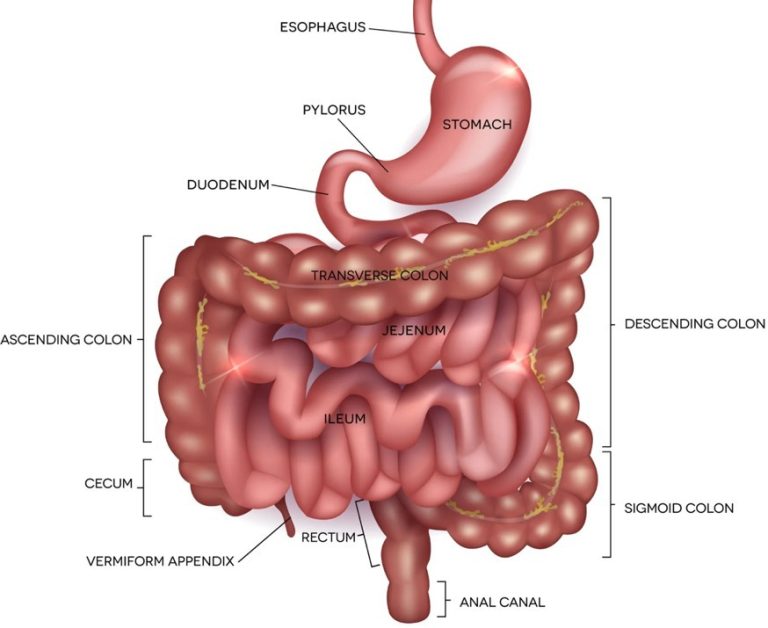
Our intestines are divided into two groups – the small intestine, and the large intestine. Food is digested down into its simple, absorbable components in the small intestines, while the waste is pushed into the large intestine for eventual evacuation during bowel movements.
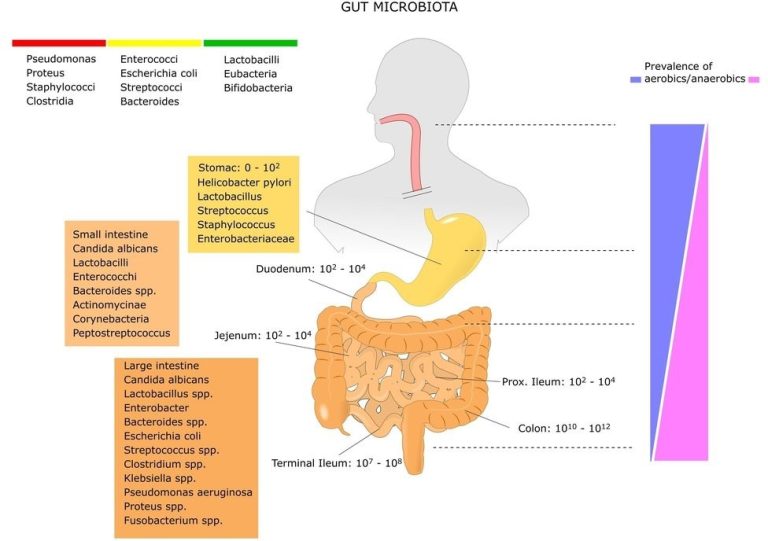
Over 99% of our gastrointestinal bacteria should reside in our large intestine. At most, only 1% of our bacterial communities should exist in our small intestines. In SIBO, much more than 1% are residing in the small intestine, which wreaks havoc with our digestive processes.
The primary reason for this significant difference lies in the fact that gastrointestinal bacteria are fermenters of constituents found in our food. When bacteria ferment these constituents, they become significant producers of gas. Our small intestines have a very small diameter when compared to the large intestine. This smaller diameter allows for the efficient digestion of food and absorption of nutrients but does not allow enough space for excessive bacterial gas production.
When someone develops SIBO, there is now an excessive number of bacteria residing in the small intestines. This leads to an excessive amount of fermentation of constituents in our food, which ultimately leads to excessive bacterial gas production in our small intestines. This gas can lead to a significant expansion and ballooning out of the small intestines, which leads directly to gas-related symptoms, as well as symptoms one may not at first correlate with excessive gas production in the intestines.
Types of SIBO
There are 3 distinct forms of SIBO that can develop. A patient can have anywhere from 1 to all 3 types occurring, and it is very common to have at least 2 forms occurring at the same time.
SIBO breath testing confirms exactly which form(s) your patient has developed.
The 3 types of SIBO are classified by the type of gas the bacteria produce:
- Hydrogen (H2) producing SIBO
- Methane(CH4) producing SIBO
- HydrogenSulfide (H2S) producing SIBO
Mechanism of SIBO Symptoms
The primary constituents found in our food that gastrointestinal bacteria feed on, are primarily the FODMAPs:
- Fibres – specifically soluble fibre
- Sugars – specifically fructose and lactose
- Oligosaccharides
- Sugar alcohols
The above constituents are fed on and fermented by Hydrogen (H2) producing and Hydrogen Sulfide (H2S) producing bacteria. The single species of Methane (CH4) producing bacteria does not ferment and use these constituents as part of its metabolism. It has its own special fuel source listed below. Hydrogen Sulfide (H2S) bacteria share one of these special fuel sources. These extra fuel sources are:
- CO2 gas – used by CH4 producing bacteria
- H2 gas– used by CH4 and H2S producing bacteria
- Sulfur compounds – used by H2S producing bacteria
When the bacterial overgrowth feeds on and ferments any of the above constituents, they will produce a significant amount of their gas in the small intestines. This leads to the expansion of the small intestines and ultimately leads to the litany of SIBO symptoms.
SIBO symptoms can include:
- Excessive abdominal distension/bloating
- Excessive trapped gas and abdominal pressure
- Excessive flatulence (extremely pungent smelling in some cases)
- Excessive eructation
- Abdominal pains
- Halitosis
- GERD
- Nausea
- Diarrhea
- Constipation
Causes of SIBO
The primary reason why people end up with SIBO is because of a dysfunctional migrating motor complex (MMC). This can be caused by multiple factors, including gastroenteritis.
There is a clear and distinct connection between contracting a case of bacterial gastroenteritis (food poisoning/traveller’s diarrhea) and developing SIBO and/or IBS soon afterwards4,5,6. Depending on the study, anywhere between 1 in 9 to 1 in 5 people will develop SIBO/IBS after a case of bacterial gastroenteritis.
The piece that connects gastroenteritis and IBS, is SIBO. There is significant evidence that clearly shows how a case of food poisoning or traveller’s diarrhea leads to SIBO.
The migrating motor complex (MMC), and specifically, Phase III of the MMC, is how we have been hard-wired to not develop SIBO from a very young age. Phase III creates high intensity and high frequency smooth muscle contractions of the intestines to push waste from the small intestines into the large intestine. These contractions that occur every 3 hours (on average) throughout the day sweep bacteria from the small intestines into the large intestine, thus forcing bacteria to remain in the large intestine. If the MMC becomes dysfunctional, the sweeping of the small intestines is not as effective, bacteria can then begin to over grow in the small intestines, and thus SIBO can develop.
How does bacterial gastroenteritis lead to long-term damage to the MMC function in many people? The answer is an autoimmune cross-reaction* that can occur in patients after a bacterial gastroenteritis infection. The immune system produces an antibody called anti-vinculin. When this occurs, the gastrointestinal immune system will target and damage components of the MMC for many months, leading to decreased MMC function, and ultimately SIBO/IBS develops

*More information on this autoimmune cross reaction and how to test your patient for a history of it, please visit our IBS
Smart page.
Other compounding factors that can lead to SIBO are low stomach acid, bile insufficiency, intestinal strictures, opiate medication use, and MMC changes due to Celiac disease, Crohn’s disease, and ulcerative colitis.
In conclusion, SIBO occurs when bacteria that normally live in high concentrations in the large intestine, overgrow in the small intestines, leading to uncomfortable digestive symptoms. This is frequently the result of damage to the MMC, slowing the smooth muscle contractions that sweep food and toxins out of the small intestines and into the colon. This damage to the MMC can be caused by food poisoning or traveller’s diarrhea, and the resulting SIBO can also be the root cause of an IBS diagnosis.
Ask your doctor if a SIBO Lactulose Breath test or IBS-SMART Blood test is right for you!
References -:
- https://www.sciencedirect.com/science/article/abs/pii/S0002927000021614
- https://jamanetwork.com/journals/jama/article-abstract/199251
- https://www.ncbi.nlm.nih.gov/pmc/articles/PMC3949258/
- https://pubmed.ncbi.nlm.nih.gov/28069350
- https://bmcgastroenterol.biomedcentral.com/articles/10.1186/1471-230X-13-46
- https://www.ncbi.nlm.nih.gov/pmc/articles/PMC4759150/
- https://pubmed.ncbi.nlm.nih.gov/12498278/
- https://link.springer.com/article/10.1007%2Fs10620-007-9977-z
- https://pubmed.ncbi.nlm.nih.gov/25424202/