

- Clinical Precision
About: IBS-Smart® Blood Test
SIBO Diagnostics
Is Proud To Be The Exclusive
Canadian Partner Of IBS-Smart®

Help determine the root cause of your
patients’ IBS with a simple blood test
Does your patient have IBS-D or IBS-M? If so, the ibs-smart® blood test for IBS can be a valuable diagnostic tool.
The validation study for ibs-smart® shows that elevated biomarkers indicate IBS with up to 100% positive predictive value. Furthermore, this test is highly specific in distinguishing between IBS and IBD.
The correlation between these biomarkers and the development of SIBO is also clearly evident. SIBO has been shown to be a primary root cause of IBS. If a patient has both elevated ibs-smart® biomarkers and SIBO, a vicious cycle of gastrointestinal motility dysfunction can occur, leading to a chronic progression of IBS signs and symptoms.
Determining if your IBS/SIBO patient has developed these elevated biomarkers can be crucial to the proper treatment of their case. Especially in regard to preventing relapse of their condition.
Post Infectious IBS & ibs-smart® Biomarkers
Post-infectious IBS (PI-IBS) is caused by a case of bacterial gastroenteritis, also known as food poisoning.
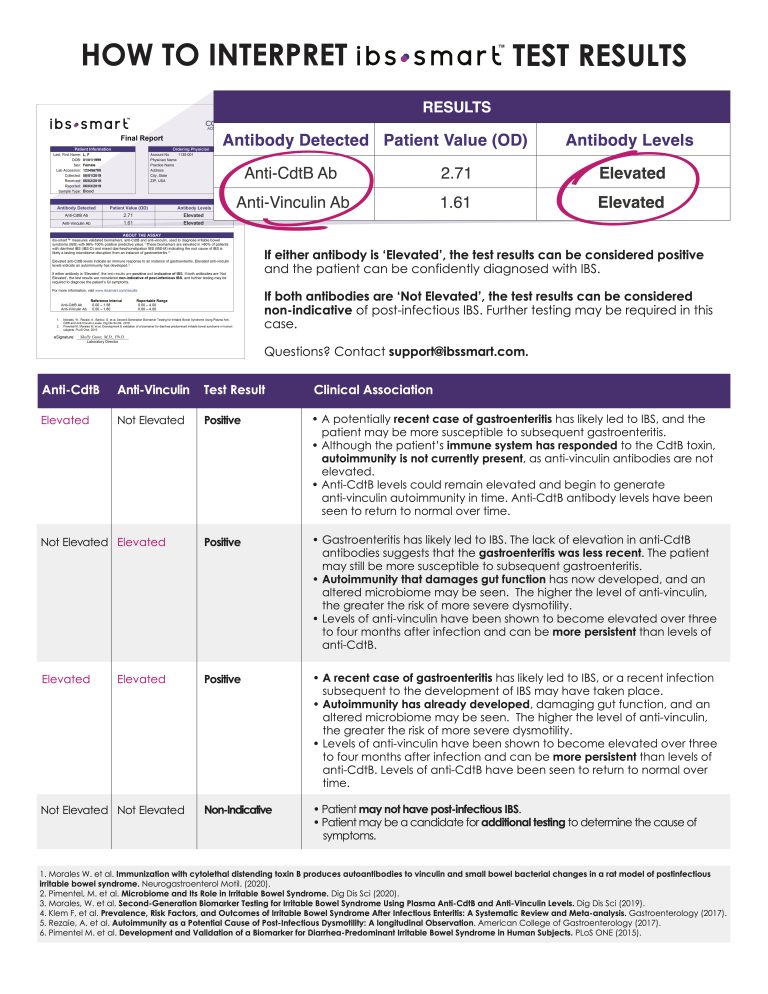
PI-IBS typically has a diarrheal component, leading to either IBS-D or IBS-M. PI-IBS can be determined by using the ibs-smart® test to measure two specific antibodies: anti-CdtB and anti-vinculin.
A significant volume of research shows a clear link between food poisoning and IBS, specifically diarrhea-predominant IBS (IBS-D). A 2017 45 study review conducted at the Mayo Clinic showed that 1 in 9 patients who experience food poisoning develop IBS.

How Does Food Poisoning Lead to IBS?
The most common bacteria that cause food poisoning are Shigella, Campylobacter, C. difficile, Salmonella, Yersinia, and E. coli. Each one of these bacteria release the CdtB toxin upo infection of the gastrointestinal tract. Each one of these bacteria release a toxin called Cytolethal Distending Toxin B (CdtB).
When the CdtB toxin is present within the GI tract, the immune system mounts a response by producing an antibody called anti-CdtB. Unfortunately, the CdtB toxin looks similar to vinculin, which is a naturally occurring protein within the smooth muscles of the intestines, that is critical in proper and healthy GI motility – specifically the migrating motor complex (MMC). Because CdtB and vinculin can look alike, the immune system can mistakenly think that it needs to attack vinculin, at which point it begins producing an anti-vinculin antibody.The production of anti-vinculin is an autoimmune cross reaction response and leads to GI enteric nerve damage and improper functioning of the Interstitial Cells of Cajal (ICC) and the Migrating Motor Complex (MMC). When these do not function properly, the small intestinal microbiome balance can be significantly disrupted and SIBO can develop. Once a dysbiosis such as SIBO develops, it can be the primary cause behind IBS-D and IBS-M symptoms.
It is important to note that IBS/SIBO can develop a long time after the food poisoning infection. Many patients may not remember the initial incident that may have led to their IBS symptoms. The ibs-smart® test can clearly determine if the food poisoning-IBS/SIBO connection is present.
FAQs
What does the IBS-Smart blood test measure?
The test measures anti-CdtB and anti-vinculin antibodies, biomarkers associated with post-infectious IBS and gastrointestinal motility dysfunction.
Who may benefit from IBS-Smart testing?
The test may be helpful for patients experiencing IBS-D or IBS-M symptoms, particularly when post-infectious IBS is being considered.
Can the IBS-Smart test distinguish IBS from IBD?
Yes. The validation study demonstrated that the test is highly specific in differentiating IBS from Inflammatory Bowel Disease (IBD).
What is the connection between IBS-Smart and SIBO?
Elevated IBS-Smart biomarkers have been associated with motility dysfunction that may contribute to the development of SIBO in some patients.
Can IBS develop long after food poisoning?
Yes. Symptoms of post-infectious IBS may appear or persist long after the original food poisoning event, and some patients may not remember the initial infection.